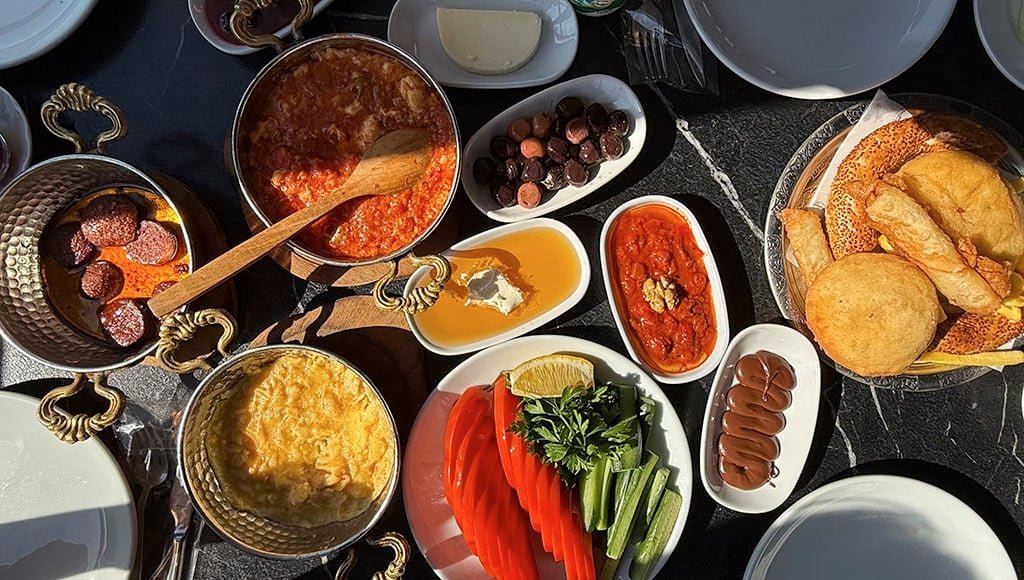
Our weekdays, filled with tasks and responsibilities, often work against the culture of taking time to linger over food in the morning. Visiting places like Türkiye offers another perspective. Life there is every bit as busy, yet the breakfast culture is faithfully cherished and protected.
It has not always been this way. Before the modern breakfast tradition took shape, Anatolians typically began their day with a bowl of soup – nutritious and hearty, prepared according to the recipes of Ottoman physicians. Even today, Turkish people will happily eat soup at any hour.
The elaborate breakfast culture we now know, however, is largely a product of modernisation that took fuller form in the 20th and 21st centuries. Its character was shaped by two indispensable drinks that still punctuate the morning: coffee and tea.
Coffee arrived in Türkiye via the Red Sea trade routes from Egypt and Yemen around the mid-16th century. It quickly won over both the common people and the elite, and a distinctive method of preparation emerged.
Turkish coffee is made by grinding the beans to an extremely fine powder – finer even than espresso – then combining it with cold water (and sugar if desired) in a small pot called a cezve. The mixture is slowly heated until it foams and rises; just before it overflows, it is removed from the heat, allowed to settle briefly, and poured into small cups so that a thick foam rests on top while the grounds settle at the bottom.
The result is dense, strong, and traditionally served with a glass of water. Because it was not recommended to drink coffee on an empty stomach, the practice of eating beforehand gave birth to the meal itself – and to its name, kahvaltı, from kahve (coffee) + altı (under/before), meaning “before the coffee”.
Black tea, known simply as çay, arrived much later, in the 19th century. Influences came from Europe, Azerbaijan, and Iran, but the brewing method was adopted from the Russian samovar tradition.
In Türkiye, it is prepared in a double teapot called a çaydanlık. The upper pot holds tea leaves that steep into a strong concentrate using a little hot water from the lower pot, which is kept constantly warm. When serving – usually into a tulip-shaped glass – the concentrate is diluted with more hot water from below.
Türkiye now consumes more tea per capita than any other country in the world, roughly 3.16 kg per person each year, much of it grown in the Black Sea region.
Flowing between tea and coffee, the Turkish breakfast is a generous parade of cheeses, olives, breads, eggs, vegetables, and condiments. Türkiye produces around 190 varieties of cheese and, depending on the region, many of them may appear on the table. The most ubiquitous is beyaz peynir, a white cheese made from sheep’s, cow’s, or goat’s milk (or a mixture) and similar to feta.
One of my favourites is tulum peyniri from Eastern Anatolia, made by maturing sheep’s or goat’s curd inside a goatskin bag (tulum). Another is kaymak, a rich clotted cream often served with honey. Cheese also appears in mıhlama, a molten pot of stretchy cheese and cornmeal – a kind of Turkish fondue – eaten by scooping it up with bread. The long, elastic threads of cheese become a playful contest at the table.
Olives are equally varied. The three main styles are çizik (slit), salamura (brined), and sele (dry-salted). The latter are my absolute favourites. In the sele method, olives are layered with generous amounts of salt; as they slowly lose their bitterness, they develop a concentrated, almost meaty flavour, and are finished with a coating of olive oil.
Eggs appear in many guises. Especially lovely are menemen – scrambled eggs gently cooked with tomato and pepper – and sucuklu yumurta, eggs fried with the spiced beef sausage known as sucuk.
Bread is the quiet star of the kahvaltı spread. The deeply golden, sesame-studded simit takes centre stage; torn into pieces, it becomes the perfect vehicle for cheese and jam. Sold on every corner, it is a portable meal in itself. Then there is boyoz, a small, flaky, savoury pastry from İzmir, often eaten with tahin-pekmez, a glorious mixture of tahini and grape molasses.
Börek is the umbrella term for a family of savoury pastries usually made with yufka, a slightly thicker and more pliable relative of phyllo. Gözleme is simpler still: a thin sheet of dough is filled, folded, and cooked on a griddle until golden and lightly crisp. Both are commonly filled with white cheese, spinach, minced meat, potatoes, or mixed vegetables.
Conscious of how many dishes I have already named, I will stop here, knowing I am leaving countless others unmentioned. I will keep them for another time and another journey to Türkiye.
The Turkish breakfast is more than a meal; it is a cultural institution that must be experienced. Whether you favour eggs or pastry, sweet or savoury, cheese or none, this magnificent spread leaves no one unaffected. And the cup of coffee that follows arrives, as it should, on a full and happy stomach.
Read more about food from Ratatouille: a last taste of summer