
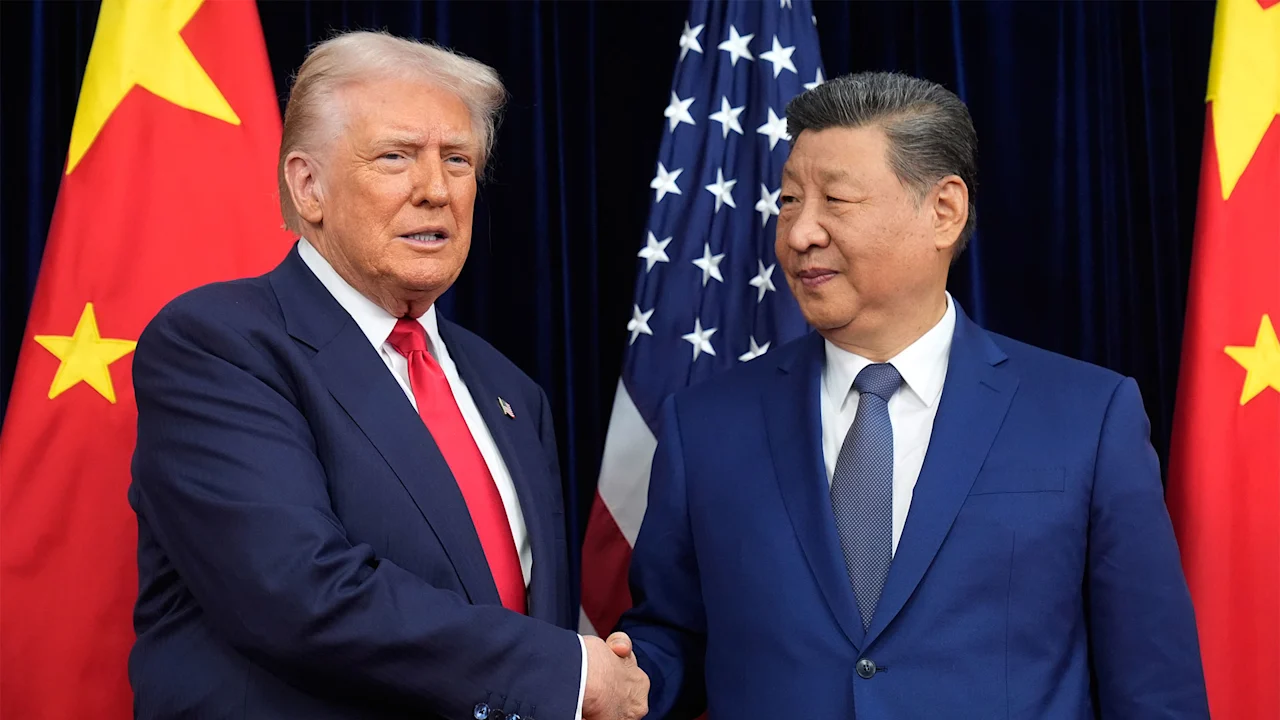
Long before this week’s trip to China, President Donald Trump was already predicting on social media that his Chinese counterpart, Xi Jinping, would “give me a big, fat hug when I get there.” However, Beijing’s strong economic ties to Iran, along with ongoing trade tensions stemming from tariff threats since Trump’s first term, could diminish the warm sentiments during his visit to Beijing. Although Trump has often praised Xi, viewing him as a competitor deserving of respect, these underlying issues may cast a shadow over their meeting.
Trump has recently expressed a preference for avoiding lengthy flights or extended absences from the White House or his properties in Florida and New Jersey. He is set to arrive in Beijing on Wednesday night, participate in a welcome ceremony the following morning, and have a private meeting with Xi before they tour the Temple of Heaven, a 15th-century religious complex symbolizing the relationship between Earth and heaven.
On Thursday evening, Trump will attend a state banquet and will have a tea and working lunch with Xi on Friday before departing, according to White House spokesperson Anna Kelly. Their discussions will focus on establishing a new Board of Trade to maintain dialogue on economic matters, while prioritizing key industries like energy, aerospace, and agriculture.
China’s Foreign Ministry spokesperson Guo Jiakun noted on Monday that Beijing is ready to collaborate with the U.S. based on equality and mutual respect to enhance cooperation and manage differences, adding stability to a tumultuous world. He emphasized that diplomacy between the leaders plays an essential strategic role in bilateral relations.
While there will be significant ceremonial elements during the visit, the grandeur is not expected to match Trump’s first visit to China in 2017, which Beijing labeled a “state visit-plus.” Jonathan Czin, a former director for China at the National Security Council, indicated that given the current tensions, a lavish reception was unlikely.
During Trump’s previous trip, China warmly welcomed him, with military music and children waving flags. Xi provided a tour of the Forbidden City, where Trump and First Lady Melania Trump had a private dinner — a privilege reserved for emperors since the establishment of the People’s Republic of China in 1949. The following morning featured another welcome ceremony at the Great Hall of the People, including a military parade and a state banquet.
Ali Wyne, a senior adviser for U.S.-China relations, suggested that the Chinese delegation will strive to ensure Trump views this visit as exceptional. However, he noted that the ceremonial aspects will serve a different purpose than during Trump’s initial visit, as Xi now has a better grasp of Trump’s character, and U.S. national security strategy acknowledges China as a near-peer competitor.
Expectations for substantial achievements during this trip may be more tempered, Czin stated, predicting that the Chinese might refrain from offering significant breakthroughs on trade or other issues, as they may be strategizing around the upcoming U.S. midterm elections. The GOP is focused on retaining control while polls show general dissatisfaction with Trump’s economic policies and approaches regarding Iran. Still, the White House maintains the view that Trump’s previous firm stance on tariffs has kept the U.S. in a favorable position.
Kelly remarked, “President Trump cares about results, not symbols,” but added that the summit will hold both symbolic and substantive significance due to Trump’s solid relationship with Xi.
Trump may meet with Xi several times within the next eight months. Following his Beijing visit, he plans to host Xi at the White House and might attend the Asia-Pacific Economic Cooperation meeting in Shenzhen, with Xi potentially coming to the Group of 20 summit at Trump’s Doral resort in Florida. Czin noted that Xi is not fond of travel, which could impact these planned encounters. He also pointed out that Xi tends to eschew personal connections, having recently executed a military purge that replaced officials with longtime personal ties to his family.
Wyne suggested that Xi recognizes he might not encounter another U.S. president who admires him as much as Trump does, which may lead Xi to seek as many economic and security concessions from Trump as possible.
Trump has frequently lauded Xi, indicating during a 2024 interview that Xi was “actually a really good … I don’t want to say ‘friend,’ but I got along with him great.” He has even posited that military intervention might not be necessary to deter Chinese advances on Taiwan due to Xi’s respect for him, despite more recent discussions about potential arms sales to Taiwan.
Since his return to the White House, Trump has continued to highlight the bilateral relationship, even after his Beijing visit was postponed amid the early stages of the Iran conflict. He made unsuccessful attempts to encourage China to help reopen the Strait of Hormuz, though China utilized its influence as a significant purchaser of Iranian oil to facilitate a fragile ceasefire.
The White House expects Trump to apply pressure on China regarding Iran, given Beijing’s economic ties to Tehran. The ongoing conflict could negatively impact its economy, which is already projected to grow more slowly. However, if China can contribute to establishing lasting peace, it could enhance its bargaining power in trade discussions with the Trump administration.
During his 2017 visit, Trump announced $250 billion in nonbinding trade deals, many of which did not materialize. A subsequent round of trade agreements in 2020 valued at $200 billion also largely failed to deliver before the conclusion of Trump’s first term. More recently, Trump’s announcement of extensive global tariffs resulted in China halting U.S. soybean purchases and restricting exports of essential rare earth minerals.
There has been a degree of easing tensions since the U.S. achieved a trade truce last fall, which has limited tariffs on both sides. The White House indicates ongoing discussions aimed at extending this truce, with both parties supporting such efforts. Kelly emphasized, “Trump doesn’t travel anywhere without bringing deliverables home to our country,” asserting that Americans can expect the president to secure further advantageous deals for the U.S. during his time in China.
Associated Press writer E. Eduardo Castillo contributed from Beijing. —Will Weissert, Associated Press.